
Spa & Beauty Sales
Spa Group Booking Enquiries: Sell the Shared Visit, Not Just Four Separate Slots
Group spa enquiries need more than a treatment menu. Help organisers explain what matters, give reception a clearer request and avoid promising the wrong visit.

Reply.my Editorial Team
Practical guidance reviewed for clear implementation steps, responsible AI boundaries and honest claims. How we prepare our guides.
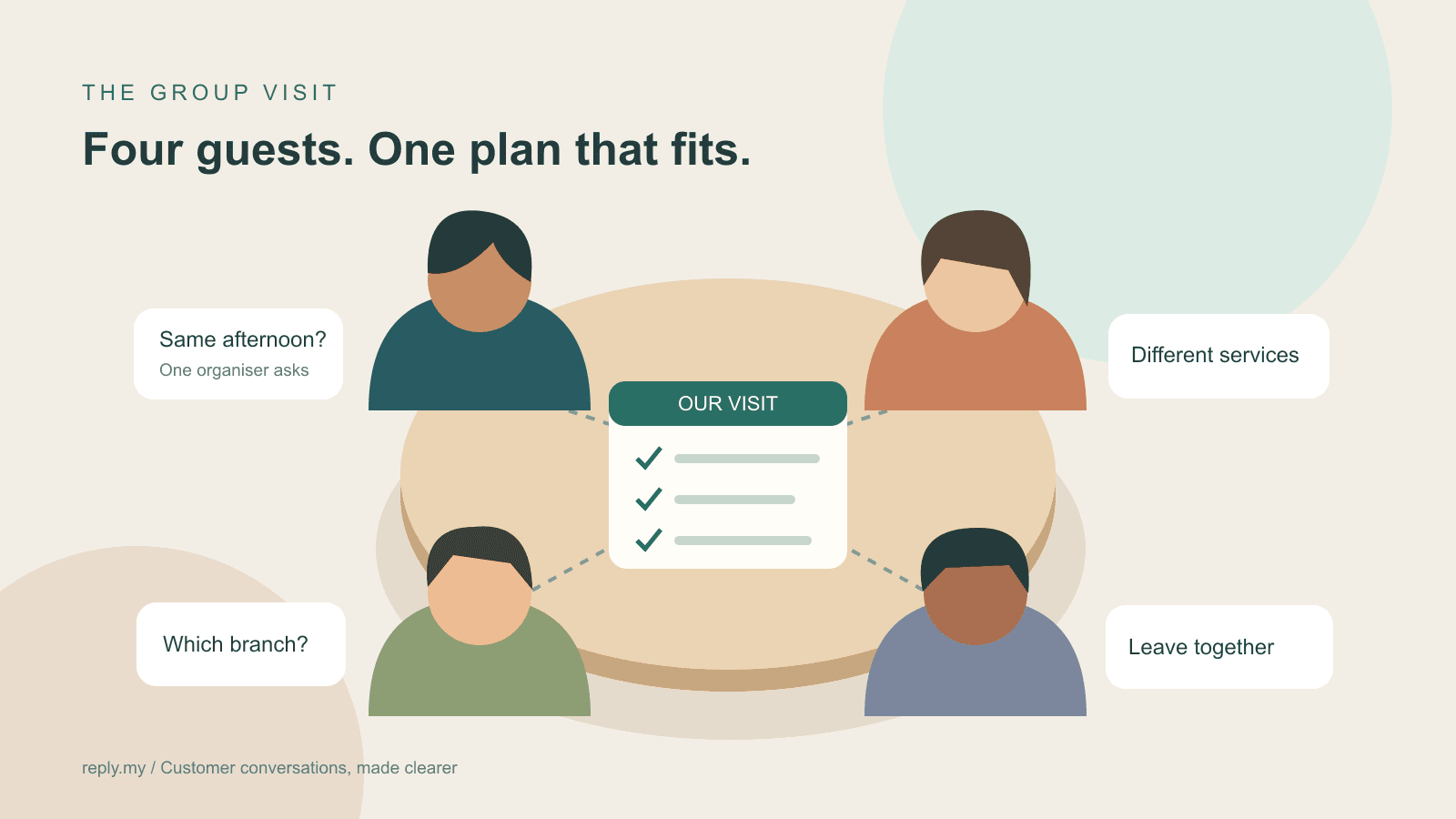
Four friends want a spa afternoon. Your receptionist sends four available appointment times. The organiser replies: ‘But can we all finish before dinner?’ The team answered a booking question. It did not yet answer the group’s question. Spa group booking enquiries are requests to coordinate a shared visit, not simply multiply a single appointment. Understanding what must happen together helps reception offer something the organiser can actually accept. For a busy owner, that means less repeated checking before the customer has enough information to decide.
‘Together’ can mean three different things
For one couple, together means treatments in the same room. For a group of friends, it may mean starting at the same time. For a birthday organiser, the important condition may be everyone leaving by a particular hour.
Those are different requests. A branch could have enough appointments over the afternoon without being able to meet any of them.
Ask a plain question early: ‘Is it most important to start together, share a room, or finish by a certain time?’ Offer only arrangements your business actually provides. This gives the organiser a way to explain the occasion without requiring them to understand your room or staff schedules.
Group enquiries receiving separate attention is not just a theoretical distinction. In Malaysia, Mildern Spa’s booking page directs group, spa-party and event customers to contact the business about their requirements. That is one operator’s approach, not a rule for every spa.
Does reception keep rebuilding the same proposal?
Look for these patterns in recent group enquiries:
- The number of guests changes after staff have checked several appointments.
- A customer receives a per-person price but cannot work out what the whole visit includes.
- Reception learns about a fixed departure time only after suggesting treatments.
- Two branches check the same group without knowing another outlet is involved.
- A second guest messages separately and receives an answer that contradicts the organiser’s discussion.
One organiser, one useful next answer
The organiser is often carrying out two jobs: asking your business for options and checking those options with everybody else. Silence may mean they are waiting for friends, not that the enquiry is unimportant.
Help them take one understandable answer back to the group. Establish the likely number of guests, preferred branch, date and the shared requirement. If the headcount is uncertain, keep that uncertainty visible rather than silently treating it as final.
Answer their opening question before collecting a long list of names. Someone asking whether couples can share a room needs that approved information first. You do not need every guest’s contact details to explain your general room options.
A small team with occasional group requests may manage well with a short shared enquiry note. Automation becomes worth discussing when staff repeatedly gather these details while other customers wait.
A Friday visit that looked easier than it was
The following scenario is fictional. It is not a Reply.my customer case, an available package or a measured result.
An organiser asks a PJ spa about four friends visiting on Friday afternoon. Two want a facial and two want a massage. They need to leave together by 5 pm.
‘Four people on Friday’ is not enough for reception to make a helpful suggestion. The service mix and departure time matter more than sending the most popular package.
A useful first reply: ‘I can help gather the request for our team. Do all four of you need to start at the same time, or would different start times work if everyone finishes before 5 pm?’
Organiser: ‘Different start times are fine. We just need to leave together.’
Now reception has a meaningful request: four guests, two service types, PJ on Friday, staggered starts acceptable, departure by 5 pm. Staff can check appropriate options without guessing what the group will accept.
The reply after checking should say what is actually available and what remains to be agreed. A collected request is not a reservation. Booking confirmation still requires staff or a verified booking connection to reserve the necessary appointments.
Make the offer easy to pass on—not easy to misunderstand
The organiser may forward your answer to a group chat. A short, self-contained explanation is more useful than a series of fragments spread across a long conversation.
Include the proposed branch and date, the service options, how the visit would be arranged and whether the quoted amount is per person or for the group. Make clear what is confirmed and what is still only being checked.
If a deposit or special group condition applies, explain the business’s actual terms before asking the organiser to proceed. Do not let an assistant invent a group discount because several guests are interested.
Also avoid implying that a proposal holds the appointments unless your team has genuinely reserved them. ‘These are the options we can discuss’ and ‘Your appointments are confirmed’ lead customers to make different plans.
If your wider problem is conflicting package answers, the guide to consistent spa promotion replies covers that separately. Here, the aim is to make one group’s proposed visit understandable.
Where Reply.my fits before the availability check
Reply.my’s service offering includes FAQ assistance, enquiry qualification, customer fields and human handover. For group enquiries, those capabilities are relevant to explaining approved service details and gathering the preferences reception needs before checking options.
Instead of another message saying only ‘Group interested—please call’, the intended handover can preserve the headcount, service interests and shared timing requirement. The actual fields and handover scope should be agreed for your business.
This is an omnichannel conversation, not a WhatsApp-only one. An organiser may first ask on Instagram or Messenger, while another group uses Telegram or WhatsApp. Discuss the supported connections your team needs and how staff will continue each request. Connecting channels does not automatically establish which accounts belong to the same group.
Reply.my’s spa enquiry service is a relevant starting point for this discussion. It is not a promise of automatic group scheduling, room allocation, deposits or split payments. Those are separate requirements to verify if you need them.
Keep personal questions personal
The organiser can coordinate a date without becoming responsible for everybody’s private circumstances. Do not ask them to collect friends’ medical details in a shared chat so an assistant can choose treatments.
A guest asking about personal suitability should reach appropriately qualified staff through a suitable private conversation. General service descriptions and appointment preferences can remain separate from that discussion.
Similarly, when a second guest contacts another branch, establish which enquiry they mean before sharing someone else’s information or changing the group’s arrangements. A matching first name is not enough. Keeping one agreed contact for logistics can reduce contradictory instructions, while still allowing each guest to ask private questions.
Did the organiser receive something they could say yes to?
Review the quality of the proposed visit, not just the speed of the first reply. Could the organiser understand the timing? Did the offer meet the shared requirement? Did reception have to redo the work because an important preference was missing?
A polite decline after a clear proposal is different from a customer disappearing while waiting for a basic answer. Keep those outcomes separate when judging your enquiry process.
Better conversation handling cannot create room or therapist capacity. Its value is helping the team identify a workable option sooner—or explain honestly when no suitable option exists.
Questions owners ask about group enquiries
Should every guest complete a separate enquiry form?
Not necessarily for the initial enquiry. One organiser can explain the group’s general preferences. Individual details should be requested only when needed for the actual service or booking, using the business’s appropriate process.
What if the group does not know the final headcount?
Record the current estimate as provisional and explain when a final number is needed under your actual terms. Do not present a quote or availability check for an estimated group as a confirmed arrangement for any group size.
Can we suggest a different branch?
Yes, if the customer is open to it and the alternative genuinely fits the shared visit. Ask before checking another location; a branch with more capacity may be inconvenient for the group.
Will an AI chatbot manage a WhatsApp group chat for us?
Do not assume that handling customer enquiries on a messaging channel includes participating in group chats. Confirm this requirement separately. The approach described here concerns an organiser’s enquiry to your business.
Are group requests taking too many messages to become clear?
Bring Reply.my one anonymised group enquiry where reception had to check the same visit more than once. Explain what changed: headcount, treatments, branch or timing. That gives us a specific conversation to discuss, rather than a vague request to automate bookings.
You can also review plans and pricing, then confirm the channels, enquiry details and staff handover your team needs.
Discuss My Group Enquiry Workload