
Spa Customer Experience
Spa Accessibility Enquiries: Explain the Route, Not Just ‘Yes’
Answer spa accessibility questions with verified entrance, room and facility details. A practical guide for Malaysian beauty centres and multi-branch teams.

Reply.my Editorial Team
Practical guidance reviewed for clear implementation steps, responsible AI boundaries and honest claims. How we prepare our guides.
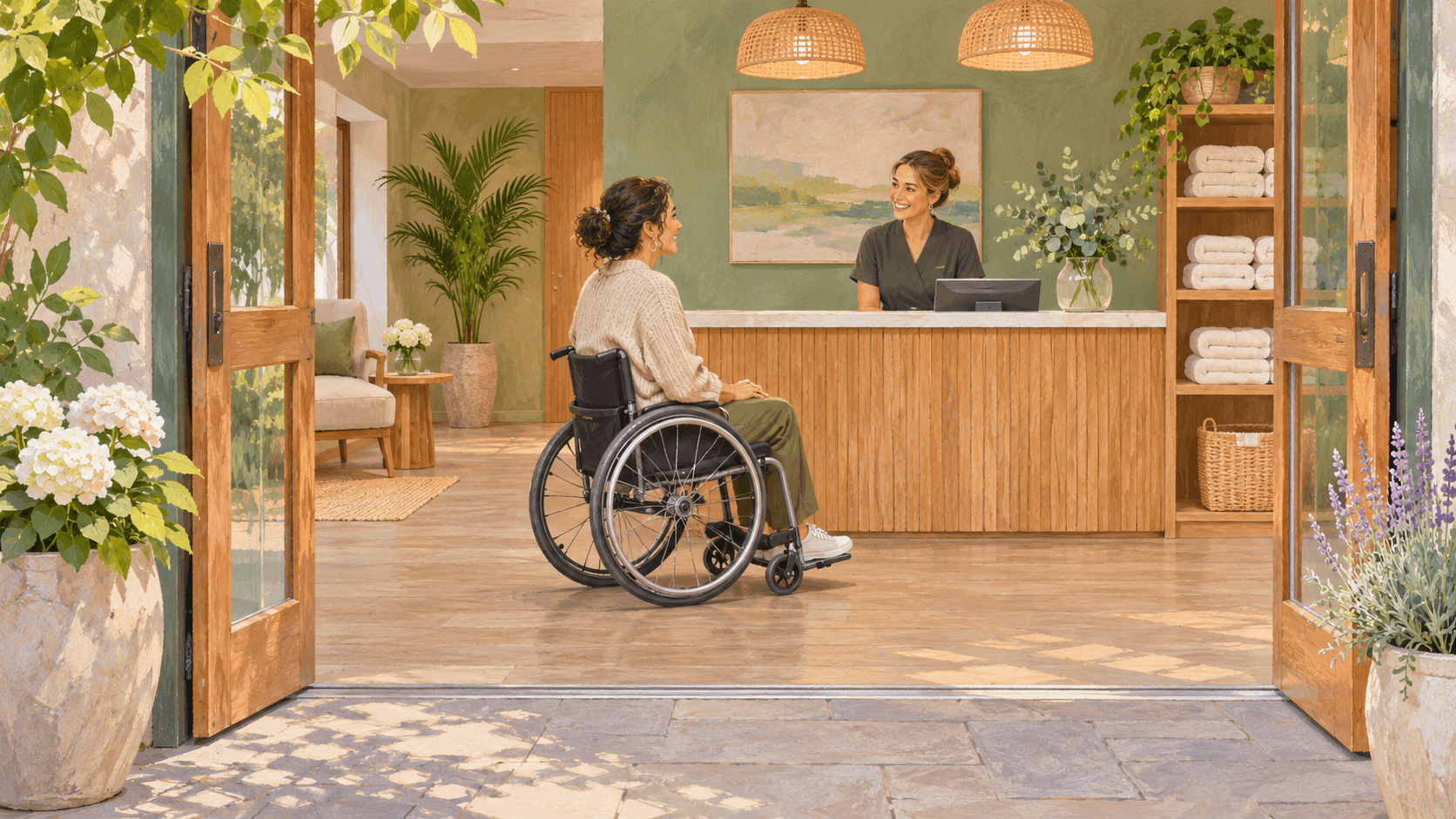
‘Is your spa wheelchair-accessible?’ A reassuring ‘yes’ is easy to send. It is less useful if the customer later discovers that reception is step-free but the room they need is upstairs. The question deserves facts about the visit, not a friendly guess.
For Malaysian spas, beauty centres and multi-branch service businesses, accessibility enquiries are an opportunity to explain the premises clearly before someone travels. AI can help repeat verified information. It cannot inspect your entrance, certify accessibility or decide what will work for an individual customer.
Replace one broad label with a useful description
Accessibility is not a single feature that reception can safely infer from a ramp photograph. A customer may need to know about the path from the drop-off point, a doorway, a lift, the service room or a toilet. A correct answer about one part does not settle the others.
Google's Business Profile attribute guidance separates wheelchair-accessible entrances, restrooms, seating, parking and lifts. That distinction is useful for organising your information. It is not a substitute for checking your premises or a certification that a particular visit will be suitable.
Start with the customer's actual question. If they ask about steps, answer about steps. If they ask a broad question, offer a short description of the verified route and ask which facilities they would like more detail about. Do not make them complete a sales questionnaire first.
This guide concerns physical-access information in customer conversations. It is not a building-design standard, legal compliance assessment or treatment-suitability guide. Broader accessibility needs also deserve attention; a wheelchair-access answer should never be treated as covering every customer's requirements.
Follow the route the customer will actually use
Ask the responsible person at each outlet to check the journey, not just the front door. Where does the customer arrive? Is the advertised entrance the usable one? Does the route continue to the relevant service room? Note any door, change of level or shared-building facility that affects that journey.
Record factual details your team has checked, including measurements when relevant, rather than adjectives such as ‘easy’ or ‘spacious’. Do not estimate a doorway's width from a picture. If a customer needs a measurement you do not have, arrange a staff check and say that the answer is pending.
A simple branch information sheet can keep the entrance route, lift location, room location, toilet information and contact person together. Include when the details were checked and who maintains them. Those notes help staff answer consistently without pretending that every customer will use the space in the same way.
Some conditions change during the day. A shared lift may be unavailable, a usual entrance may be closed or a route may be obstructed. Give staff a way to flag a temporary change so a saved reply does not confidently repeat yesterday's arrangement. Do not claim live monitoring unless such a connection is genuinely part of the system.
A specific question does not require a medical explanation
Someone asking whether there are steps does not need to justify why they are asking. Avoid questions such as ‘What is your condition?’ when the task is simply to describe the premises. Let the customer choose which practical details to share.
A useful invitation is: ‘Would information about the entrance, the room or the toilet help you plan your visit?’ If the person requests a particular measurement or arrangement, keep the conversation focused on that request. Do not infer their abilities from the fact that they use a wheelchair or another mobility aid.
Likewise, do not assume a companion will help, speak for the customer or perform a transfer. If the customer asks about assistance, staff should confirm exactly what the business can provide. A chatbot must not volunteer lifting, carrying or improvised workarounds to overcome an access barrier.
Physical access and treatment suitability are separate questions. The relevant professional should handle individual treatment advice. Being able to enter a room is not clearance for a service, and a personal health question should not be answered by extrapolating from a facilities description.
What a more useful answer sounds like
The following fictional example describes invented premises in Shah Alam. It is not a real spa offer, an accessibility assessment or a Reply.my customer result.
Farah messages a beauty centre: ‘I use a wheelchair. Is there a step-free way to the room for a consultation?’ The branch's verified information says there is a level route through the side entrance to reception, but the usual consultation room is upstairs. Staff have not yet confirmed whether a ground-floor room can be used.
‘Yes, we are wheelchair-friendly’ would hide the unresolved part. A clearer reply is: ‘Our side entrance has a level route to reception. The usual consultation room is upstairs, so the team needs to check a ground-floor arrangement before we confirm your visit. Would you like us to check that for you?’
If Farah agrees, the staff handover should retain the actual question: step-free access to a consultation room, ground-floor arrangement not yet confirmed. ‘Interested in consultation’ loses the detail that determines whether the visit can happen as requested.
Staff should return with the checked facts, including any remaining limitations, before treating the arrangement as settled. If it cannot be provided, say so plainly. Offer another location only if its relevant details have also been checked, and let Farah choose whether to pursue it.
Keep the website, branch replies and arrival instructions consistent
Review public descriptions alongside the information reception uses. A blanket claim on a social profile can conflict with a careful answer in chat. Explain meaningful limitations where customers are likely to look, rather than waiting for someone to ask the exact question that reveals them.
Use real, current premises photographs when helpful, with a written explanation of what they show. An attractive image cannot establish the whole route or replace requested measurements. The generated header illustration on this article depicts a fictional setting; it is not evidence about any business's facilities.
For a chain, keep access details attached to the correct outlet. Identical branding does not mean identical entrances, lifts or room layouts. Our branch-handover guide discusses ownership when another team needs to respond; the important extra here is that the facilities answer must remain location-specific.
When a practical arrangement is confirmed, include it in the arrival instructions through the agreed channel. Share only the context the receiving staff need. Customers should not have to repeat a personal explanation to every employee just to receive the information already requested.
Give AI a reliable description and a clear stopping point
Reply.my's published services include FAQ assistance, customer fields and human handover. A focused setup could explain approved branch information and pass a specific unanswered access question to staff. The business remains responsible for supplying accurate premises details and delivering any agreed arrangement.
Reply.my is omnichannel, not WhatsApp-only. Confirm which messaging and social accounts are included in your proposal, then test the same question across those channels. A different app should not produce a different claim about the same doorway.
Do not assume the service includes a facilities survey, accessibility certification, live lift status or a connection to your room-booking system. Nor should an assistant decide whether a person's needs make them a suitable sales lead. Its useful job is to answer what is known and make the remaining question clear.
Try a few checks before launch: an entrance question for the wrong branch, a request for an unknown measurement and a temporary lift closure. The assistant should identify the right location, acknowledge missing information and leave unconfirmed arrangements unconfirmed. See our human-handover guide for keeping that context intact.
If your team repeatedly reconstructs these answers across channels, bring Reply.my your verified branch notes and an anonymised enquiry. We can discuss an enquiry flow that makes the practical information easier to obtain. You can compare the proposed scope with our plans and pricing; clearer public information may be the right first step before automation.
Discuss My Branch Access EnquiriesQuestions about spa accessibility enquiries
What should a spa say when asked whether it is wheelchair-accessible?
Give verified details about the relevant entrance, route, room and facilities rather than relying on a broad label. Ask which additional information would help and clearly identify anything staff still need to check.
Should customers explain their disability before receiving access information?
No personal explanation is needed to answer ordinary questions about the premises. Focus on the practical information requested and let customers choose what they share.
Can an AI chatbot confirm an accessible room arrangement?
Not from general branch information alone. Staff must verify the specific arrangement unless an explicitly authorised and reliable workflow can do so. A request is not a confirmation.
Does Reply.my assess whether a spa is accessible?
Do not assume a premises survey or accessibility certification is included. Enquiry assistance can communicate the business's approved information and hand unresolved questions to staff.