
Tyre Shop Customer Enquiries
AI Chatbot for Tyre Shops: Make the Quote Comparable
Help tyre customers compare the same specification, quantity and fitting services. A practical enquiry guide for Malaysian tyre shops, with clear staff boundaries.

Reply.my Editorial Team
Practical guidance reviewed for clear implementation steps, responsible AI boundaries and honest claims. How we prepare our guides.
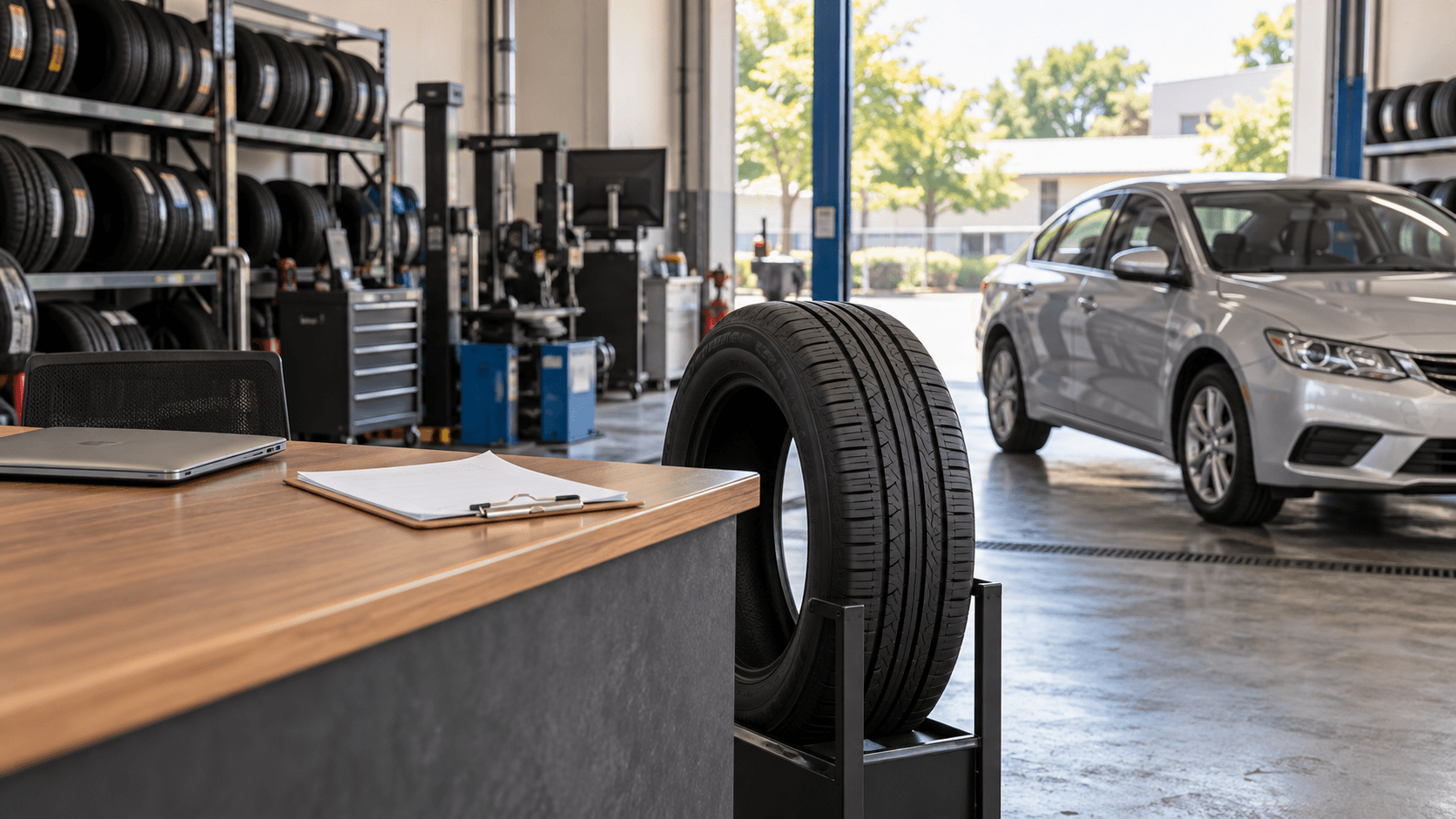
“How much for four tyres for my car?”
The customer gives a model name. Your counter team sends a price. A few messages later, the wheel size is different, the customer meant a particular tyre range, and they assumed alignment was included.
An AI chatbot for tyre shops can help collect the information needed for a useful quotation and explain approved prices and inclusions. It should help the customer compare the actual offer—not guess a suitable tyre from a car name or turn a rough enquiry into a fitment recommendation.
For Malaysian workshop owners, the opportunity is to reduce the quotations that have to be explained all over again when the car arrives.
The first number can become the whole offer
A customer who asks for a price is not necessarily ready to discuss every technical detail. They may be comparing shops during a break at work, using the car model as the only description they know.
Meet that question without pretending the missing information does not matter. Explain why one or two details are needed: “We can help with a quote. Could you share the tyre specification so we compare the right option?” If the customer does not know where to find it, offer a simple way to get help.
The purpose is not to make customers pass a technical test before receiving a price. It is to avoid sending a number that applies to something they will not buy.
Where you publish a starting price, keep the product and conditions attached to it. A general “from” figure should not reappear in a private reply as a confirmed total for an unspecified set of tyres. The more easily a message can be forwarded, the more important that context becomes.
A car name helps identify the enquiry; it does not finish it
Vehicle details are useful context, but do not treat them as a complete tyre specification. Ask for the information your trained staff actually use to prepare the quote, and let customers say when they are unsure rather than encouraging a guess.
Michelin Malaysia's guide to tyre markings explains that the sidewall carries size information as well as load and speed ratings. That is why a single description such as “16-inch” does not identify the full product being discussed.
There is another distinction worth keeping: the markings on a currently fitted tyre describe what is on the vehicle, not necessarily what should be fitted next. Continental's sidewall guide advises checking against the vehicle manufacturer's information rather than relying solely on the current tyre.
An enquiry assistant can explain what information staff need and collect it. It should not approve a different size, load rating, wheel combination or substitution. Qualified staff should verify suitability against the vehicle requirements, especially if the customer reports modifications or uncertain details.
If the customer sends a photograph, retain the uncertainty when the markings are unclear. Asking for clarification is more useful than silently turning a blurry character into a confident specification. Do not assume that photo reading or automatic fitment lookup is included in a chatbot service.
Keep four parts of the quotation together
Once staff have enough information to quote, make the reply understandable as a complete offer. A tyre brand alone is not enough if the customer is comparing different ranges, and a unit price is not enough if they are expecting a fitted total.
The following is a quotation checklist, not a price list or a recommendation about what any vehicle needs.
| Part of the offer | What the customer should be able to understand |
|---|---|
| Product | The quoted brand, range and specification, with any outstanding suitability check stated. |
| Quantity | Whether the amount is per tyre, for the requested quantity, or for a defined package. |
| Included work | Which fitting-related services are included, and which are separate or subject to assessment. |
| Availability and visit | What has actually been checked at the requested branch, and whether a visit is requested or confirmed. |
“Same brand, cheaper price” may not be the same comparison
A customer forwards another shop's message and asks whether you can match it. Before negotiating, check whether both messages describe the same product and work. You do not need to criticise the other shop to make your own offer clear.
For example, ask whether the comparison is for the same tyre range and specification, the same quantity and the same included services. If the other message is incomplete, explain your quote on its own terms instead of filling the gaps with assumptions.
Be particularly clear with words such as “installation included” or “full package”. State the services your shop has actually included. Do not imply that alignment, valves, balancing or other work is automatically included simply because the customer expects it. Equally, do not recommend extra work just to make a package look more comprehensive; any need for assessment belongs with the workshop team.
If the customer changes the requested quantity or product, restate the relevant offer. Avoid replying with a new total that leaves them unsure which earlier inclusions still apply. The latest message should be usable without making the customer reconstruct a long chat.
A quote that survives being forwarded
Consider this fictional example, not a real offer, vehicle recommendation or Reply.my customer result.
A driver asks for four tyres and gives only the car model. The assistant asks for the specification and whether the driver has a preferred tyre range. The driver replies that they are comparing two quotes and mainly want to know the fitted total.
At this point, a helpful response is not “Yes, we can beat it”. It is: “I'll pass the specification and your request for a fitted total to the counter team. They can confirm the product, included services and stock at your preferred branch.”
After staff prepare the actual offer, the customer asks: “Can I send this to my husband?” The reply should be easy to forward: the named tyre and specification, quantity, approved price basis, included work and any checks still outstanding. It should not depend on an earlier message saying “same as above”.
The driver then asks whether alignment is included. If it is separate, the team says so before the visit, using the shop's actual terms. That is not a failure to close the sale. It is the moment the customer learns what they are comparing.
The next employee should receive that question with the enquiry. Otherwise, the customer may hear a different interpretation when they reach the counter.
Do these corrections keep reaching your counter?
Review recent quotation chats alongside the clarifications made in person. These signs suggest the first answer needs more context:
- Customers arrive quoting a price for a different specification or tyre range.
- Staff explain repeatedly that an amount was per tyre rather than for the full request.
- An inclusion mentioned in one channel disappears from the explanation in another.
- A customer believes stock was reserved because someone said the shop carries that brand.
- The counter team starts again because the original quote and unresolved question were not passed on.
What Reply.my can help organise—and what stays with the workshop
Reply.my offers FAQ assistance, enquiry qualification, customer fields and human handover, with multi-channel setup available according to the agreed scope. A tyre shop can discuss using these capabilities to collect the relevant request and explain approved quotation terms across supported channels.
This is an omnichannel conversation problem, not just a WhatsApp reply problem. A customer may first see a social post, ask through Instagram and continue on another channel. Staff need the agreed product context and unanswered question, not merely another notification.
Confirm which channels are included and how employees continue an enquiry. Do not assume automatic cross-channel identity matching, live stock visibility, reservation actions or a connection to the workshop's pricing system. A saved product description is not proof that the requested quantity is available at that branch.
Keep fitment decisions, damage assessment and driving-safety questions with qualified staff. An assistant should not pronounce a tyre safe to use, diagnose a problem from a chat or encourage a customer to drive in when they have raised a safety concern. The purpose here is clearer commercial communication, not remote mechanical approval.
Our human-handover guide explains how to preserve context when a person takes over. The business chatbot guide covers the wider buying decision.
Start with a clearer quote, then decide whether to automate
If one counter employee handles a modest number of enquiries well, a shared quotation format may be enough. Fix unclear product descriptions and package wording first; automating an ambiguous offer will not make it easier to compare.
If staff repeatedly collect the same missing details across several channels, an assistant may be worth evaluating. Ask it to demonstrate your real quotation questions, including “Is that for four?” and “What does fitting include?” Use your own approved information rather than a polished generic demo.
Look for fewer corrections and a smoother first conversation at the counter. Do customers understand the price basis? Does the receiving employee know which question is still open? Those observations matter more than the number of instant greetings.
You can review pricing against the enquiry volume, channels and staff support you need. If your team keeps rebuilding tyre quotes after customers arrive, bring Reply.my an anonymised conversation and one current offer. We can discuss where clearer explanations and handover would help.
Discuss My Tyre Shop Enquiries