
Customer Experience
After-Hours Customer Service: What Happens Between Closing Time and the Next Reply?
Customers message after closing time. Learn what to answer, what should wait for staff and how to make the next morning’s enquiries easier to handle.

Reply.my Editorial Team
Practical guidance reviewed for clear implementation steps, responsible AI boundaries and honest claims. How we prepare our guides.
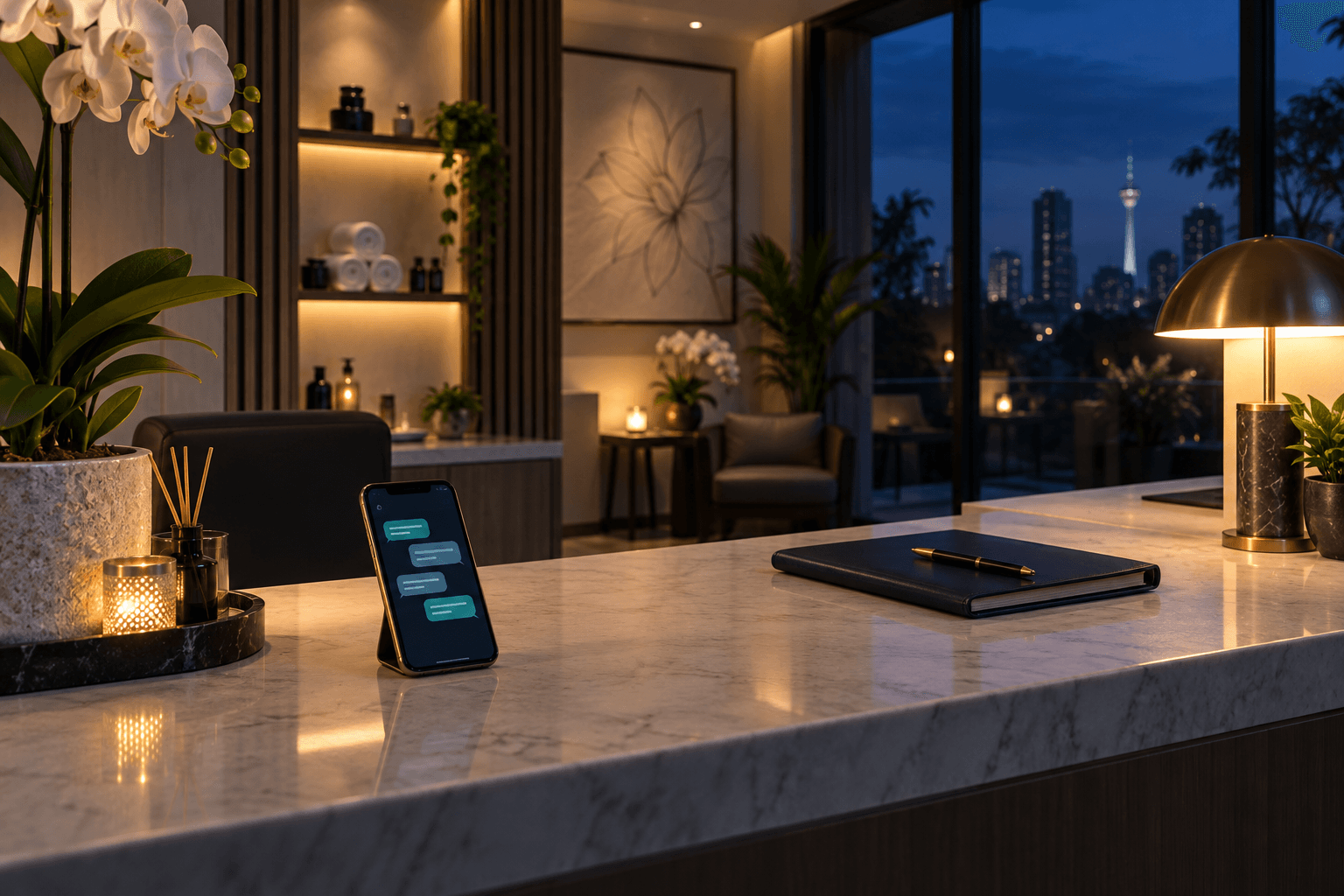
The lights are off at your beauty centre. Your advertising is still running.
At 9:42 pm, someone asks whether the package they saw is available at your nearest branch. They are not necessarily expecting a full consultation tonight. They may simply want enough information to decide what to do tomorrow.
What happens next depends on more than whether your inbox sends an automatic greeting.
After-hours customer service means giving customers appropriate help outside staffed hours, while being clear about what must wait for an employee. It can range from an honest away message to approved answers and an enquiry that the morning team can continue.
For a spa, beauty centre or multi-branch business, the goal is not to pretend the whole operation stays open all night. It is to avoid leaving customers confused about whether anyone will help.
Follow the fictional evening below. The times, customers and branch arrangements are illustrative—not a Reply.my customer case study or a promised response schedule.
9:42 pm: the customer needs one detail, not a sales presentation
“Does the facial package apply at your PJ branch?”
A generic “Thank you for contacting us” confirms receipt but does not answer the question. A long brochure may be no better if the branch condition is buried inside it.
If current, approved information is available, a suitable assistant could explain the relevant branch condition. If it is not available, the reply should say that the team needs to check. Guessing is worse than being clear about a limit.
This is the first distinction to make when evaluating after-hours support: an acknowledgement is not the same as a useful answer.
For your own business, separate questions that have stable published answers from those that depend on a person or a live system. Opening hours and directions may be straightforward. A package exception or a disputed balance is not.
9:45 pm: the question becomes an appointment request
The customer now asks, “Could I come tomorrow after work?”
This is where an apparently helpful conversation can go wrong. Collecting a preferred time does not mean the business has reserved it.
Without a reliable booking connection that actually secures an appointment, the response should describe a request for staff to check. It should not announce that the customer is booked.
In this fictional example, the assistant could say: “I can note your request for PJ tomorrow after 6 pm. Reception will check availability when the team returns. This is not a confirmed appointment.”
Ask only for details needed to continue. The customer should not have to complete a long interview just to discover that the branch is closed or the service is unavailable.
The useful overnight result is a clear request—not an artificial impression that every action has been completed.
10:10 pm: a different customer needs a person
Another message arrives: “The amount charged doesn’t match what I was told.”
A promotional response would be inappropriate. So would an automated promise of a refund that nobody has authorised.
The immediate job is to acknowledge the issue, explain when the appropriate team can review it and avoid collecting unnecessary sensitive information in chat. Do not ask customers to send full payment-card details.
An example, only if the stated hours are accurate, is: “I’m sorry there’s a concern about the charge. Our team returns at 10 am tomorrow and will need to review this with you. Please don’t send card details here.”
For clinics and wellness services, after-hours chat should also have clear limits around health-related questions. It is not a substitute for professional assessment or emergency assistance. Do not present an unattended inbox as an urgent-care channel.
Different enquiries need different treatment. That is why extending response coverage should not mean sending every customer through the same sales flow.
Before opening: the most important part may still be unfinished
By morning, several people have left messages. Some received the information they wanted. Some requested availability. One is waiting for a payment query to be reviewed.
If the team sees only a pile of conversations, the overnight replies may have moved the work rather than reduced it.
A useful morning review distinguishes what still needs action:
| Overnight enquiry | What the team needs to know | Next action |
|---|---|---|
| Question answered using approved information | What was asked and answered | Review only if another action is needed |
| Preferred appointment time collected | Service, branch, timing and unconfirmed status | Check availability and respond |
| Package condition unclear | The exact question and what remains unverified | Confirm the condition before replying |
| Payment concern | The concern and any relevant non-sensitive context | Send to the responsible employee |
A conversation should not be treated as complete solely because an automatic response was sent. Someone still needs to own the action that was promised.
For multi-branch businesses, this also means avoiding a request being passed from outlet to outlet without anyone accepting it.
Opening time: what should the first human reply do?
Return to the first customer. They asked about the PJ package and left a preference for tomorrow after 6 pm.
“Hi, how can we help?” makes them start again.
A more useful continuation is: “Hi, I’m following up on your PJ appointment request for tomorrow after 6 pm. I’m checking the available options for the package you asked about.” Only say this when the employee is actually doing that work.
The benefit comes from continuity: the staff member knows what happened overnight, and the customer can see that their earlier messages mattered.
If the preferred option cannot be offered, provide a relevant alternative rather than another generic sales message. Our customer follow-up message guide includes examples for branch and timing changes.
Do you need an away message, AI assistance or staffed coverage?
Not every business needs the same level of after-hours service. Choose according to the questions arriving and the consequences of waiting.
- An away message may be enough when overnight volume is low and customers mainly need to know when staff return.
- AI-assisted answers may be worth considering when many enquiries concern approved service information or straightforward request collection.
- Staffed coverage may be necessary when customers regularly need judgement or actions that cannot appropriately wait. Automation is not equivalent to an on-duty employee.
If you use an away message, make it specific. State the actual staffed hours, whether an answer must wait and what useful information the customer can leave. Avoid “We’ll reply shortly” when nobody will return until the next day.
Holiday hours and branch differences matter. A central message saying “We open tomorrow” may be misleading if the requested outlet is closed.
For a broader comparison of the options, read AI chatbot vs live chat.
One service standard, several channels
Your customer may arrive through Instagram, Messenger, WhatsApp, Telegram or another channel your business supports. Staff availability and the accuracy of your answers should not depend on which app they happened to choose.
The wording does not have to be identical everywhere. The underlying promises should be consistent: which team is available, what can be answered and what still needs checking.
Before choosing a platform, confirm each required channel connection and its messaging limitations. Do not assume an automated action works in the same way on every service.
A shared view can help staff find outstanding conversations, but connecting channels does not automatically identify the same person across different accounts. Our omnichannel inbox guide explains that distinction.
Is overnight coverage actually helping?
Start with a sample of enquiries received after closing time. Count how many were simple information requests, how many needed staff and how many became appointment requests.
Then look beyond the time of the first reply:
- Did the customer receive an accurate answer or an honest explanation of what must wait?
- Did staff continue without asking the same opening questions?
- Were promised actions completed after the team returned?
- Did any customer mistakenly believe an appointment was confirmed?
- How much review and correction work did the morning team still need?
Compare similar periods and account for changes in promotions and appointment capacity. More overnight chats do not automatically mean more revenue, and an instant response alone does not show that the enquiry was resolved.
What happens to your enquiries after the lights go off?
If the main gap is not knowing what happens between closing time and the next staffed reply, that is a specific problem to discuss—not a reason to buy every automation feature.
Reply.my’s published packages include FAQ setup, lead qualification and human handover, with multi-channel enquiry setup and follow-up workflows in broader packages. Confirm how the proposed scope would handle your opening hours, branches and required channels; these package descriptions are not a promise of round-the-clock human support.
Tell us when your team stops replying and what customers usually ask afterward. Discuss which questions could receive useful help overnight and which should reach staff the next day.
You can also view plans and pricing when comparing the scope and ongoing costs.
Discuss My After-Hours Enquiries